 Chad Keates
South Africa’s Most Dangerous Scorpions
Southern Africa plays host to approximately 150 species of scorpion, only a fraction of which are of medical concern to humans. While every scorpion is venomous, the toxicity of the venom varies widely between species, resulting in varied reactions to stings. While most stings are nothing more than a pin prick, others can feel more like a bee sting with pain or comfort for a couple of hours. Only a select few result in severe pain or in rare cases…life threatening symptoms.
While it’s easy to say that just a handful are dangerous, scorpion identification can be quite challenging even for the best of naturalists. Lucky for us, the dangerous scorpions are all found in one genus, and they are called thick-tailed scorpions (Parabuthus). While few old-wives tails’ carry merit in the natural world, the one about scorpion tails’ is in fact true. It’s all about the tail and its size relative to the pincers. Scorpions with big tails and small pincers are more dangerous than scorpions with thick pincers and small tails. This is illustrated well in the picture below with the dangerous Parabuthus and the harmless Hadogenes.


This brings us back to our most dangerous group, the thick-tailed scorpions (Parabuthus). Although southern Africa supports just over 20 buthids, only two of these are of capable of taking human life. These are the Rough Thick tail scorpion (Parabuthus granulatus) and the Transvaal Thick tail scorpion (Parabuthus transvaalicus). Together, these scorpions account for several fatalities each year.

“The Rough Thick tail scorpion is 3x more dangerous than the Transvaal Thick tail scorpion based on lab results”
Bergman 1997
The most dangerous scorpions in South Africa are discussed in detail below. You can basically view the list that follows as the four most dangerous scorpions in South Africa.
Rough Thick tail scorpion (Parabuthus granulatus)

Size: Up to 18cm.
Distribution: Found in bushveld and karoo habitat throughout the drier western half of South Africa.
General: A variably coloured scorpion that is often found in scrapes or burrows beneath shrubs and other debris, in sandy environments.
Danger: Very Dangerous. Southern Africa’s most venomous scorpion, responsible for several fatalities each year. It is capable of taking human life if left untreated. Medical treatment should be sought immediately if envenomation occurs. Antivenom is effective on the venom of this species.


Transvaal Thick tail scorpion (Parabuthus transvaalicus)

Size: Up to 15cm.
Distribution: Found in bushveld habitat throughout most of Limpopo, and the northern parts of Gauteng, North-West and Mpumalanga.
General: Large, dark brown/black scorpion that can be found beneath rocks, logs and other fallen debris in rocky areas. Also known to venture into houses in search of food.
Danger: Very Dangerous. It is a medically important species that can present serious symptoms if large amounts of venom are injected. Medical treatment is recommended following an envenomation. Deaths have been recorded and antivenom is available if necessary.


Schlechter’s Thick tail scorpion (Parabuthus schlecteri)
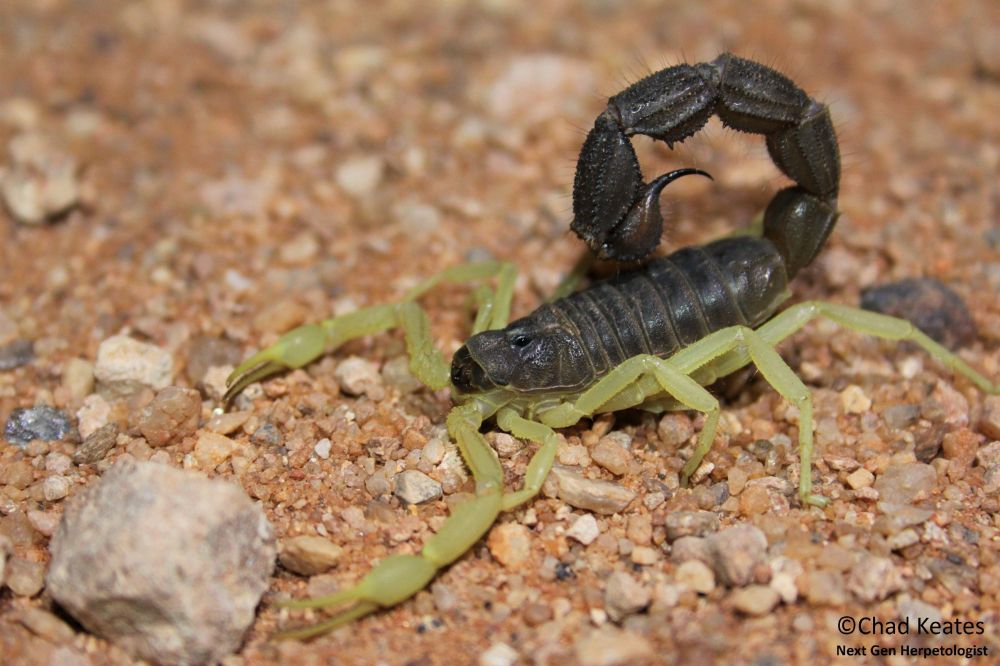
Size: Up to 12cm.
Distribution: Found in the central and northern reaches of Western Cape, where it extends through central Northern Cape into Namibia. Found in karoo and kamaqualand vegetations within these areas.
General: A dark brown/black scorpion with lighter-coloured legs. It constructs shallow burrows/scrapes beneath rocks in sandy/gritty soils. Although relatively widespread, the species is infrequently encountered.
Danger: Dangerous. Stings can be painful and warrant hospitalisation, but no deaths have been recorded. Antivenom is not effective against the venom of this species.
Kalahari Thick tail scorpion (Parabuthus raudus)

Size: Up to 16cm.
Distribution: Found in Kalahari sand in north-western North-West and north-eastern Northern Cape.
General: A pale orange/yellow scorpion, which often possesses segments that are darker than the rest of the body. This species is known to build shallow burrows at the base of vegetation in Kalahari sand.
Danger: Dangerous. Stings can be painful and warrant hospitalisation, but no deaths have been recorded. Antivenom is not effective against the venom of this species.


References
ASI Newsletter. 2021. Dangerous scorpions of southern Africa. URL: https://www.africansnakebiteinstitute.com/news/newsletters/dangerous-scorpions-of-southern-africa/
Bergman, N.J. 1997. Scorpion sting in Zimbabwe. South African Medical Journal, 87(2), pp.163-167.
Leeming, J. 2019. Scorpions of southern Africa. Penguin Random House South Africa.




Thank you for this interesting, informative and well-illustrated post.
LikeLike